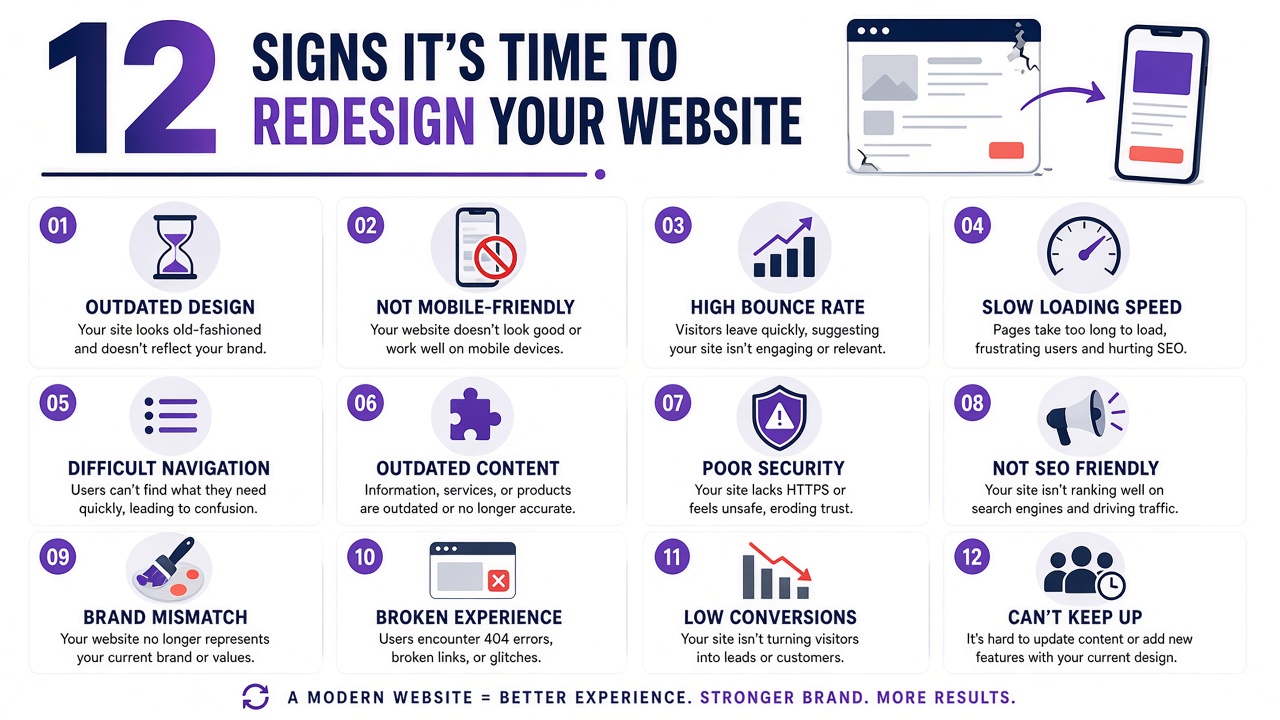
A website rarely becomes ineffective overnight. More often, small problems accumulate: information falls out of date, new pages are added without a clear structure, mobile visitors struggle with old layouts, and the site no longer represents what the business has become. Because these changes happen gradually, it can be difficult to recognise when routine updates are no longer enough and a full website redesign is justified.
A redesign should not be treated as a cosmetic exercise or a response to every new visual trend. It is a strategic project that should address measurable problems, improve the customer journey and support clear business goals. The following signs can help you distinguish between a website that needs a few targeted improvements and one that needs more fundamental change.
Your website no longer reflects your business
Businesses evolve. Services change, teams grow, audiences shift and positioning becomes more focused. If your website still describes an earlier version of the company, visitors may form an inaccurate impression before speaking to you. This disconnect is especially damaging when the business has moved upmarket, entered a new sector or developed expertise that the existing site does not communicate.
Review the homepage, service pages, imagery, case studies and calls to action. They should tell a consistent story about who you help, what you offer and why customers should choose you now—not several years ago.
The design looks dated or inconsistent
Visual age alone is not a reason to rebuild a useful website, but an outdated appearance can weaken credibility. Common warning signs include cramped layouts, tiny type, low-quality imagery, excessive effects and inconsistent buttons or page styles. These details can make an established business appear neglected.
Inconsistency often develops when different suppliers add pages over time. A website redesign can introduce a coherent design system for typography, colour, spacing, forms and reusable components, making future updates easier as well as improving appearance.
Mobile visitors receive a poor experience
A site may technically shrink to fit a phone while still being frustrating to use. Look for hard-to-read text, buttons placed too close together, horizontal scrolling, oversized images, awkward menus and forms that require excessive zooming or typing.
Test important journeys on real phones, including finding a service, reading a product page, submitting an enquiry and completing a purchase. If mobile fixes require repeated workarounds because the underlying layout is inflexible, redesigning with a mobile-first approach is likely to be more effective.
Pages are slow to load
Large images, obsolete code, excessive scripts and poorly chosen plugins can all damage performance. Slow pages create friction before visitors have even seen the message, and problems may be worse on mobile connections than on office Wi-Fi.
Not every speed issue requires a redesign; image compression, caching and technical maintenance may be enough. However, when poor performance is rooted in the platform, theme or page-building approach, a cleaner rebuild can provide a stronger long-term foundation.
Visitors struggle to find information
Navigation should reflect the questions and priorities of customers. If users rely on search to locate basic information, repeatedly contact the business for answers already on the site or abandon journeys midway, the information architecture may be failing.
A redesign provides an opportunity to audit content, simplify menus and group information logically. Card sorting, analytics and usability testing can reveal how customers expect content to be organised rather than relying on internal company structures.
Enquiries or sales are declining
Falling conversions can have many causes, so avoid assuming that a fresh visual style will automatically solve the problem. Compare traffic sources, device performance, landing pages and stages in the conversion journey. A weak value proposition, unclear pricing, hidden delivery costs or a confusing form may be more important than colour or imagery. A successful website redesign uses evidence to remove friction. Define the important actions, establish baseline performance and measure whether the new experience improves qualified enquiries, bookings or sales—not merely page views.
Content is difficult to update
Your team should be able to maintain routine content without risking the layout. If publishing a case study requires developer support, or editors avoid updates because the content management system is confusing, the website will gradually become inaccurate.
Redesign planning should include the editing experience. Define reusable page components, permissions, image guidance and content workflows so the site remains sustainable after launch.
Accessibility has been overlooked
Poor colour contrast, missing keyboard access, unclear focus states, unlabelled form fields and illogical headings can exclude visitors. Accessibility cannot be solved by a single plugin; it requires attention across design, content and development.
An accessibility audit may identify issues that can be repaired individually. If barriers are widespread throughout templates and components, rebuilding them with inclusive patterns can be more reliable than applying patches.
The technology creates risk
Unsupported software, abandoned plugins and undocumented custom code can introduce security and maintenance problems. Frequent conflicts or unexpected breakages may indicate that the site's technical foundation has become fragile. Before redesigning, inventory integrations, redirects, analytics, forms and essential content. A visually successful launch can still fail if historical URLs disappear, tracking breaks or business-critical systems are not tested carefully.
Your brand and content lack trust signals
Customers look for evidence before committing. Missing case studies, old testimonials, vague claims, anonymous stock photography and incomplete contact details make evaluation harder. A redesign can create appropriate places for proof rather than scattering it as an afterthought.
Use authentic evidence: specific customer outcomes where supported, professional credentials, useful reviews, clear policies and real examples of work. Trust is built through consistency and transparency, not decorative badges alone.
The site cannot support future plans
Perhaps you need online booking, ecommerce, multilingual content, account areas or integration with internal systems. Adding major functions to an inflexible site may produce a complicated collection of plugins and compromises. Document near-term and realistic future requirements before selecting a platform. Good redesign decisions balance current needs with extensibility without paying for speculative complexity.
Small fixes have become a recurring cost
When the same layout, performance or maintenance problems return repeatedly, individual fixes may no longer represent good value. Track what is being repaired, how often and what effect it has. This creates a rational basis for deciding whether to redesign.
A redesign still needs a clear scope. Preserve pages, content and features that perform well; replacing everything without evidence can destroy useful search visibility and familiar customer journeys.
How to approach a redesign responsibly
Begin with discovery rather than visuals. Clarify business goals, interview stakeholders, review analytics, audit content and speak to representative users. Identify what must be retained, improved or removed. Set measurable outcomes and prioritise the journeys that matter most.
Plan search migration carefully by mapping important existing URLs to relevant new destinations. Test responsiveness, accessibility, forms, integrations, analytics and performance before launch. After launch, monitor behaviour and resolve issues quickly. A website redesign is not finished when the new homepage appears; it succeeds when the new experience works better for customers and the business.
Final thoughts
A redesign is worthwhile when the current website creates persistent barriers that isolated updates cannot solve. The strongest warning signs combine user frustration, business underperformance and an unsustainable technical foundation. Treat the project as an opportunity to improve structure, content, accessibility and performance—not simply to modernise the surface. With evidence-led planning and careful migration, a website redesign can create a clearer customer journey and a platform that is easier to manage for years to come.