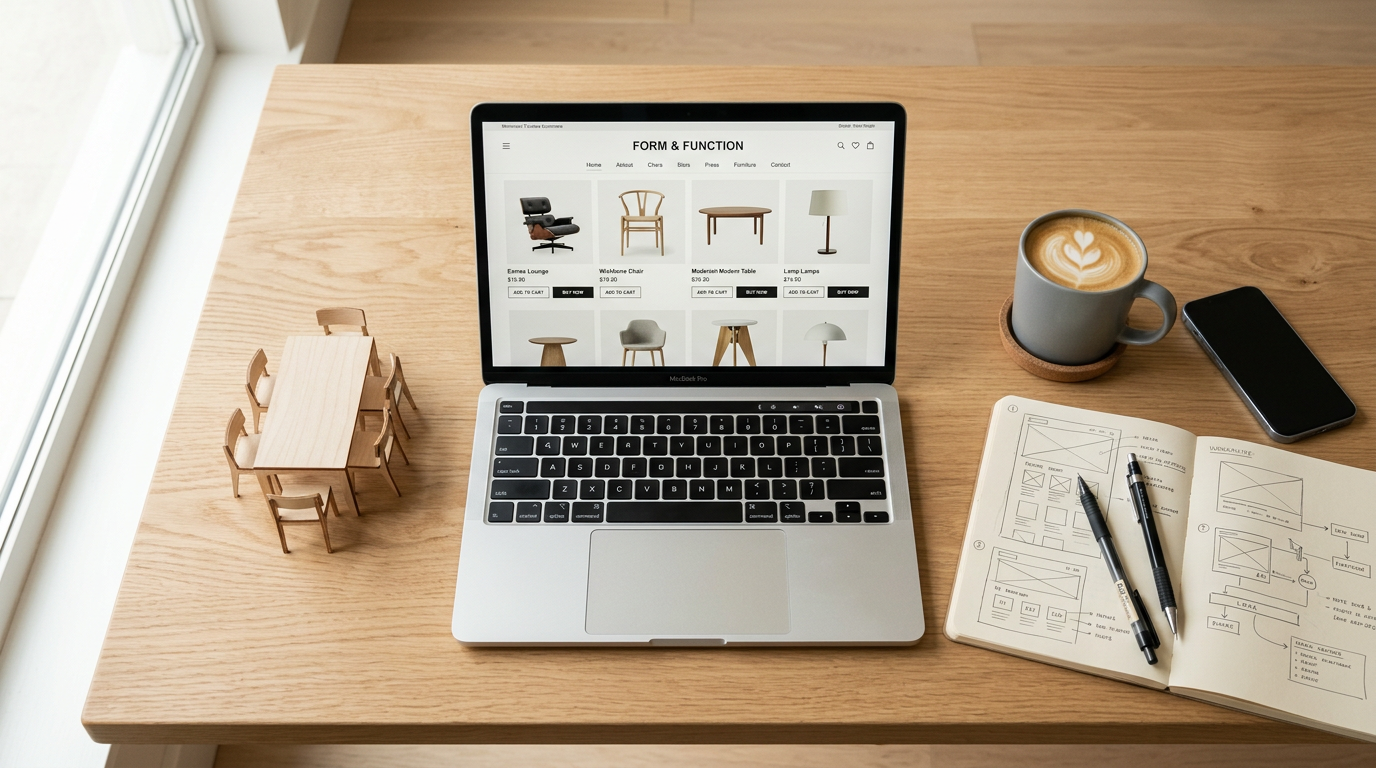
A few months ago, I set out to build an online store for a small handmade furniture brand — a business selling solid oak tables and benches made from reclaimed beams. The finished result is live now, and in this article, I want to walk through exactly how I built it: the decisions I made, the tools I used, and the mistakes I'd avoid next time. If you're considering doing the same thing, I'll also explain why, for a lot of people, it's simpler and cheaper to buy an ecommerce website instead of building one from zero.
Starting with the brief, not the design
Before opening any design tool, I wrote down what the site actually needed to do. This particular brand sells expensive, one-of-a-kind pieces — each table is cut from a single reclaimed oak beam, so no two products are identical. That meant the store couldn't work like a typical catalogue where you list "Table – Small / Medium / Large" and call it a day. Every beam needed its own listing, its own photos, and its own story (where it came from, how old it was, what condition it was in).
This single requirement shaped almost every decision that followed: the product structure, the way inventory was displayed, even the copywriting tone. If you're planning your own store, this is the step people skip the most — and it's the one that saves the most time later. Map out what makes your products different before you touch a builder or a line of code.
Choosing the stack
For this project, I built the front end as a static site and used Netlify for hosting and deployment. A few reasons for this:
Speed. Static sites load fast, which matters a lot for ecommerce — slow pages kill conversions. Simplicity. No server to manage, no database to patch, no security updates to chase. Cost. Hosting a static site is close to free until traffic gets serious. For the actual buying flow (cart, checkout, payments), I didn't build any of that from scratch. I plugged in a third-party checkout provider that handles PCI compliance, card processing, and order management. This is one of the biggest lessons from the project: never build your own payment infrastructure unless you have a very specific reason to. It's slow, risky, and there are mature, affordable tools that already do it well.
Designing around the product, not the trend
The design itself is deliberately plain. Cream background, black serif type, big photography, almost no decoration. For a product like reclaimed oak furniture — heavy, textured, expensive — the imagery needed to do the talking. Every extra design flourish competed with the product photos instead of supporting them.
A few specific choices worth mentioning:
One hero video. A 43-second clip showing a beam going from barn to finished table. This did more to build trust than any paragraph of copy could. An FAQ section addressing objections directly — will it crack, can it get up the stairs, is it really old. Ecommerce copy converts better when it answers the doubts a buyer already has, instead of just listing features. Named, numbered stock. Each beam has a number and a description, which makes a mass-produced-feeling category (furniture) feel bespoke and scarce. Testimonials with full names and locations, not "J.S., London" — specificity builds credibility. Building the product pages
Because every item is unique, I treated each product listing almost like a landing page rather than a generic template. Photos, dimensions, the beam's origin and age, and a clear price were non-negotiable on every page. I also added simple trust signals near the buy button — guarantee length, delivery process, what happens if it doesn't fit through the door — because at a higher price point, hesitation kills sales more than lack of interest does.
What took the most time
Honestly, it wasn't the code. It was:
Photography and copy for each individual product. Testing the checkout flow end-to-end, multiple times, with real test transactions. Writing the FAQ and objection-handling copy, which went through several drafts before it felt right. Performance tuning — compressing images and video so the site stayed fast despite heavy photography. If I were estimating for someone else, the actual site-building portion was maybe 30% of the total time. The rest was content, product logic, and testing.
Where I'd tell most people to buy an ecommerce website instead
Here's the honest part: building a store this way only made sense because the products themselves needed a non-standard structure, and because I was comfortable working directly with code and a static site host. For most people starting an online shop, this is not the fastest or cheapest route.
If you want to launch quickly, don't have development resources, or your products fit a fairly standard catalogue format (sizes, colours, variants), it's usually far more efficient to buy an ecommerce website rather than build one from scratch. That can mean:
A ready-made ecommerce platform subscription (with templates, hosting, and checkout built in). A pre-built store template you customize with your own branding and products. A fully built, ready-to-launch store purchased outright, which you then populate with your own inventory. The advantage of choosing to buy an ecommerce website is that the hard infrastructure — checkout, payment security, hosting, mobile responsiveness — is already solved. You're not troubleshooting deployment or payment integration; you're focused on products, photography, and marketing, which is where the actual sales come from.
What I'd do differently next time
If I rebuilt this project today, I'd:
Start product photography earlier — it was the real bottleneck, not development. Write the objection-handling FAQ before designing pages, not after. Test the checkout on mobile devices sooner rather than near the end. Seriously consider whether to buy an ecommerce website template for the base structure and only custom-build the parts that were genuinely unique (like the per-beam product listings), rather than building everything from the ground up. Final thoughts
Building this site from scratch was worth it because the product itself demanded something non-standard — unique, one-off inventory that doesn't fit a normal catalogue. But that's a fairly specific situation. For most new ecommerce businesses, the smarter move is to buy an ecommerce website with the technical groundwork already done, and spend your time and budget on what actually drives sales: good photography, clear copy, and products people want.
If you're weighing up whether to build or buy, ask yourself the same question I started with: what does my product actually require? If the answer is "a standard shopping cart and clean design," buying is almost always faster and cheaper. If your products break the mould the way these tables did, building custom might be the only way to do them justice.