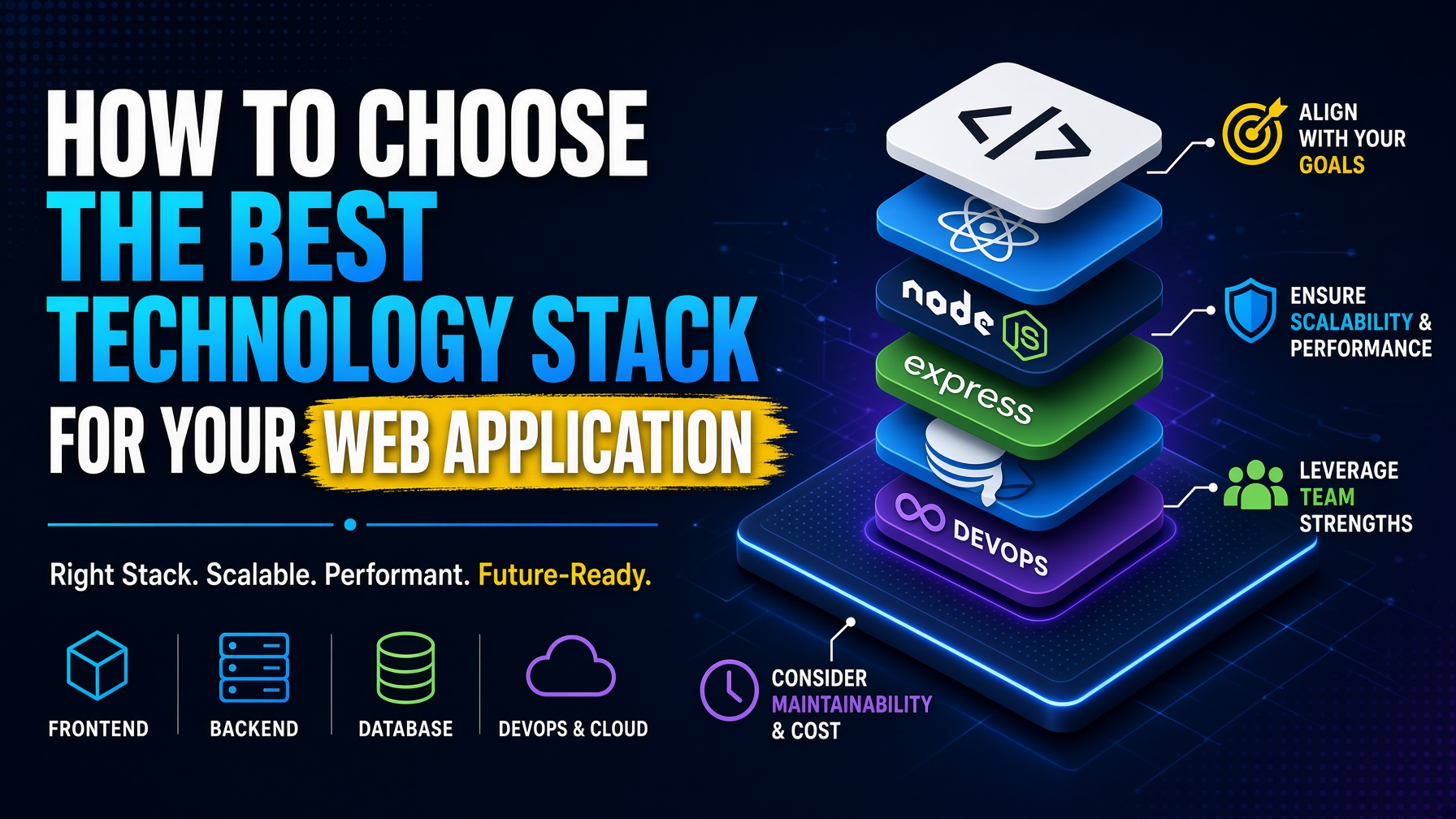
Choosing the right technology stack is one of the most important decisions you will make when planning a web application. Your chosen technologies affect development costs, performance, security, scalability, maintenance, and the overall user experience. A suitable stack can help your project operate efficiently and grow, while the wrong combination may create technical problems and expensive limitations.
Whether you are launching an online shop, customer portal, booking platform, or custom business system, your decision should reflect your goals rather than current trends alone. Working with a local web design specialist can also make the selection process easier by giving you access to relevant advice, ongoing support, and knowledge of your target market.
What Is a Technology Stack?
A technology stack is the collection of programming languages, frameworks, databases, servers, and tools used to build and operate a web application. It is usually divided into two main areas: the frontend and the backend.
The frontend is the part users see and interact with in their browsers. It includes page layouts, menus, forms, buttons, animations, and other visual components. Common frontend technologies include HTML, CSS, JavaScript, React, Vue, and Angular.
The backend works behind the scenes. It processes requests, applies business logic, manages user accounts, communicates with databases, and connects the application to external services. Backend options include Node.js, PHP, Python, Ruby, Java, and .NET.
A complete stack also includes a database, hosting environment, version-control system, security tools, and deployment process. Every component should work reliably with the others.
Begin with Your Business Requirements Before comparing frameworks or programming languages, define what the web application must accomplish. Create a list of essential features, optional features, target users, expected traffic, budget, and launch requirements.
A simple company website with a contact form has very different technical needs from a marketplace processing payments for thousands of customers. Likewise, a platform containing live chat, real-time notifications, advanced searches, or artificial intelligence features may require specialised infrastructure.
Think about your long-term plans as well. Will you add mobile applications, multiple languages, subscriptions, customer dashboards, or third-party integrations? Planning for realistic future requirements can prevent you from rebuilding the entire application later.
A local web design company can help translate commercial objectives into technical requirements. This is particularly useful when business owners know what outcome they want but are uncertain about the technology needed to deliver it.
Consider Application Size and Complexity
The ideal stack should match the scale and complexity of the project. Selecting an enterprise-level system for a small application may increase costs and slow development unnecessarily. Conversely, relying on a basic platform for a complex service could restrict performance and future expansion.
For a straightforward website or prototype, a content management system or lightweight framework may be sufficient. More complicated applications often benefit from custom frontend and backend technologies that provide greater control over features, data, and integrations.
Avoid choosing technology simply because it is popular. Popularity can indicate strong community support, but it does not automatically make a technology appropriate for every project. The best stack is the one that solves your specific problems without introducing needless complexity.
Prioritise Performance and User Experience
Application speed directly affects usability. Visitors expect pages and interactive features to respond quickly, especially when accessing a service from a mobile device. Slow applications can frustrate users and make important processes, such as registration or checkout, difficult to complete.
Your technology stack should support efficient code, database queries, image delivery, caching, and content distribution. However, technology is only one part of performance. Poorly written code can make an otherwise fast framework perform badly, while careful development can significantly improve a modest stack.
Ask how the proposed solution will handle busy periods, large files, searches, and simultaneous users. Performance testing should be included throughout development rather than left until immediately before launch.
Plan for Scalability
Scalability is the ability of an application to manage growth without suffering serious performance problems. Growth might mean more visitors, greater quantities of data, additional features, or expansion into new regions.
Not every business needs infrastructure designed for millions of users. Nevertheless, the stack should allow reasonable growth based on your commercial plans. Cloud hosting, modular architecture, efficient databases, and scalable backend services can make expansion more manageable.
Discuss whether the application can be upgraded gradually. An experienced local web design team should be able to explain how hosting resources, database capacity, and application services can change as demand increases. This approach may be more economical than paying for excessive capacity from the beginning.
Select the Right Database
The database stores and organises information such as user profiles, product details, bookings, messages, and transactions. Your data structure and access requirements should guide the choice of database.
Relational databases, including PostgreSQL and MySQL, organise information into connected tables. They are often appropriate for structured data and applications requiring clear relationships between records. NoSQL databases, such as MongoDB, can provide flexibility when handling less structured information or rapidly changing data models.
One category is not universally better than the other. Some applications even use multiple database technologies for different functions. Consider data consistency, search requirements, reporting, backup processes, security, and anticipated volume before making a decision.
Evaluate Security Requirements
Security must be considered from the beginning of the project. Your stack should receive regular updates and provide established methods for authentication, authorisation, encryption, validation, and protection against common attacks.
The required safeguards depend on the information your application handles. A public information website presents different risks from an application storing personal details or processing payments. Where relevant, your development approach should also account for privacy obligations and industry-specific requirements.
Ask who will install updates, monitor vulnerabilities, maintain backups, and respond to incidents after launch. Choosing secure technology is important, but secure configuration and continuous maintenance are equally essential.
Review Development and Maintenance Costs
The initial quotation is only one part of the total cost. You should also consider hosting, licences, integrations, monitoring, upgrades, developer availability, and future feature development.
An uncommon technology may appear innovative but become expensive if qualified developers are difficult to find. An established stack with clear documentation and a healthy community can reduce dependence on one supplier and make long-term maintenance easier.
Working with a local web design provider may offer practical benefits when maintenance is important. Local specialists can provide direct communication, understand regional business conditions, and potentially respond more efficiently when the application requires attention.
Check Integration Capabilities
Modern web applications rarely operate independently. Your application may need to connect with payment gateways, email platforms, accounting software, customer relationship management systems, maps, analytics tools, or social networks.
Confirm that the stack can communicate with the services you currently use and those you are likely to adopt. Well-supported APIs and integration libraries can reduce development time, although every connection should still be tested carefully.
You should also consider what happens if an external provider changes its service. Clear documentation and a modular integration structure make it easier to update or replace individual connections without disrupting the entire application.
Consider Your Development Team’s Expertise
A technically impressive stack is not useful if your team cannot work with it effectively. Familiar technologies can accelerate development, reduce errors, and simplify maintenance. If you already employ developers, include their expertise in the decision.
When outsourcing, ask prospective developers to explain why they recommend a particular stack. Their answer should relate to your objectives, not simply their personal preferences. Request examples of relevant work and ask how they test, document, deploy, and maintain applications.
A reliable local web design partner should communicate technical choices in straightforward language. You should understand the benefits, costs, and limitations of the recommendation before approving it.
Make a Balanced Final Decision
There is no single technology stack that is perfect for every web application. Your final choice should balance functionality, performance, scalability, security, cost, integration needs, and access to skilled developers.
Start by documenting your requirements, then compare a small number of suitable options. If necessary, create a prototype to test important functions before committing to full development. Record the reasons behind your decision so future developers understand the project’s foundations.
Most importantly, select technologies based on genuine business needs rather than hype. With careful planning and guidance from an experienced local web design team, you can build a web application that performs reliably today and remains practical to maintain as your organisation evolves.